
Clark County Sex Offender Checks
The Clark County Sheriff's Office sex and kidnap offender unit is the local starting point. The sheriff registers people who live in Clark County, assigns or applies Washington risk levels, verifies required information, and links residents to the public search. The same county page explains which levels are released and how community notice works. A name alone can be incomplete, so compare aliases, physical details, a photograph, the listed offense, and the registered place before drawing a conclusion.
Use the Clark County map or list for a local address search. Use the national system when the person may have crossed state lines. Neither result is a full criminal history. A registry record addresses a legal duty tied to a qualifying offense, while a court file holds the plea, findings, sentence, and later orders. For broader county record context, the Clark County criminal history overview separates registry, court, jail, and state repository records.
Clark County Registry Detectives
Clark County SOR detectives work from the Law Enforcement Center campus at 707 W. 13th Street in Vancouver. The public line is (564) 397-2284, and the unit accepts email at clarkcountysor@clark.wa.gov. The office is the right channel for registration questions, local compliance concerns, and reports that a listed person may not be following a duty. Emergency conduct still goes to emergency law enforcement.
The county unit sits between the person who registers and the public record. Detectives collect and verify information under RCW 9A.44.130, then publish what Washington's notification rules permit. This explains why an internal registration form may contain more than the public profile. It also explains why the sheriff, rather than a city police records desk, is the main Clark County contact.
Clark County SOR Detectives
707 W. 13th St.
PO Box 410
Vancouver, WA
(564) 397-2284
clarkcountysor@clark.wa.gov
Washington State Sex Offender Public Registry Searches
The Washington State Sex Offender Public Registry provides Clark County's public search interface. Begin with the smallest reliable fact set. A name can find a known person, while an address, city, ZIP, and radius can show registered locations around a place. The map and list are two views of the same public data. Exact radius choices may change with the registry vendor, so read the live control before relying on a distance.
- Open the official Clark County registry and read its conditions of use.
- Enter a name, or use an address, city, ZIP, and radius for a place-based search.
- Switch between map and list views, then compare more than one identifying field.
- Open the public profile and note its risk level, compliance status, offense data, and agency contact.
| Field | Type | Required | Use |
|---|---|---|---|
| Name | Text | No | Search a registrant name or alias |
| Address | Text/geocoder | No | Set a point for a mapped search |
| City | Text/dropdown | No | Narrow to a Clark County locality |
| ZIP | Text | No | Narrow with a five-digit ZIP code |
| Radius | Dropdown | With address | Defines the area around the mapped point |
| Map/List | View control | No | Changes geographic and result-list views |
The registry also offers a one-mile email alert around a selected address. Use the live signup terms, and treat an alert as a prompt to review the official Clark County profile.
Clark County Level I Registry Visibility
A missing public result does not prove that no registration record exists. Clark County explains that Level I reflects a low assessed risk and is generally not placed on the public website. Exceptions can apply when a person is noncompliant or transient. Level II and Level III entries receive broader public release because those labels reflect moderate or high assessed risk.
Risk level controls publicity. It does not set the registration term. That split is easy to miss when reading a Clark County profile. A Level II or III label tells the reader about the assessed risk and notice range, while the conviction class and statute help set how long registration lasts. Washington's labels also are not the federal SORNA tier names.
The official Clark County explanation of levels and notification shows how the sheriff applies these rules. The source image below captures that county guidance rather than a private person's profile.
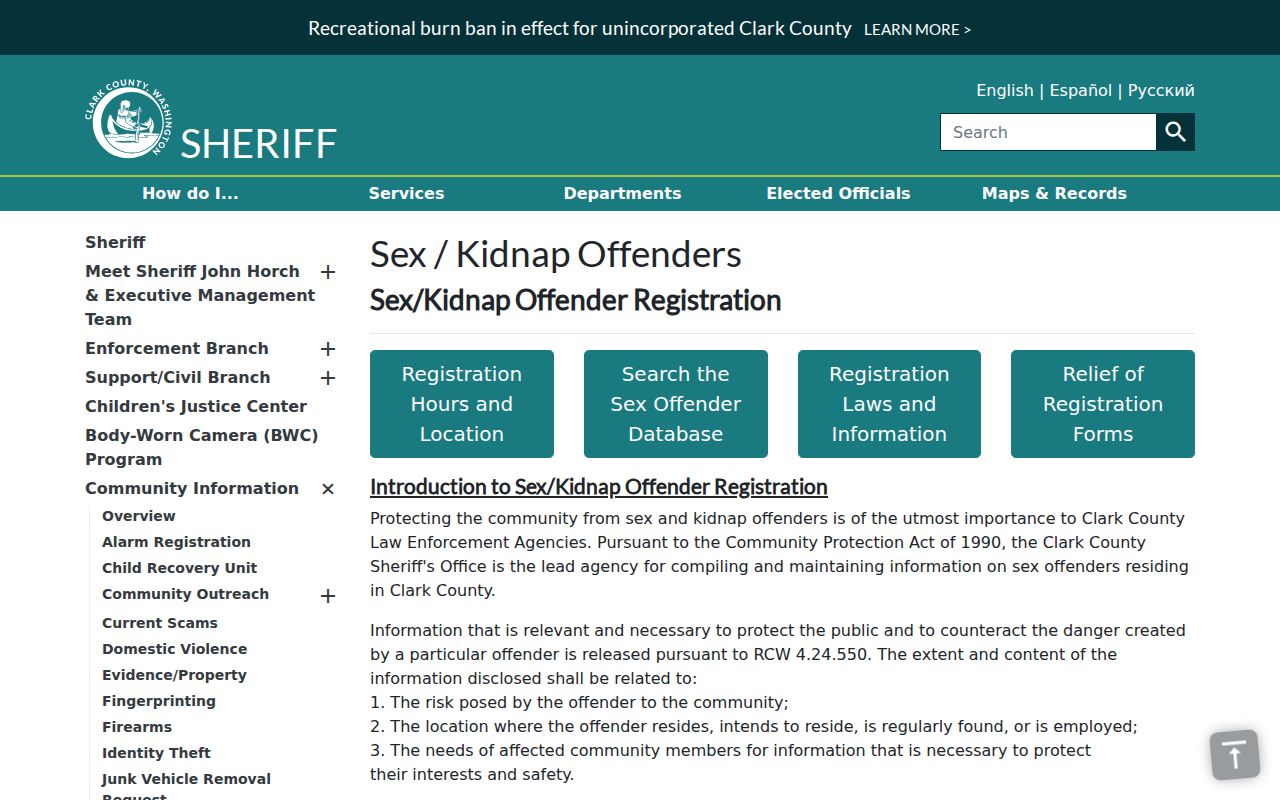
That distinction helps a reader understand why the public map is a lawful notice tool, not a list of every person who has a registration duty.
Registry Profiles: What They Show
A public Clark County registry profile combines identity, location, offense, and compliance fields that the notification rule allows. Read the record as a current public snapshot. Addresses and status can change, and a profile does not reproduce the whole court file. The offense description may name the qualifying conviction, yet it does not supply every docket event or all facts alleged in the case.
| Name and aliases | Published identity names used to distinguish possible matches. |
|---|---|
| Photo and description | Current photograph plus sex, race, height, weight, hair, eyes, and permitted age or birth data. |
| Registered place | Residence or address, transient status, and mapped location when public release is authorized. |
| Offense information | Description, jurisdiction, conviction date, and victim category when release is permitted. |
| Risk and status | Public level, registration status, compliance information, and agency contact. |
| Other public fields | Marks, tattoos, vehicle, school, or work-place details when the notification rule authorizes them. |
Use several fields together. A shared name, old photo, or nearby pin is not enough by itself. When a material detail appears wrong, contact Clark County SOR detectives rather than trying to correct or confront anyone personally.
Clark County Registry Proximity Rules
Washington does not impose a blanket statewide rule that bars every registered person from living or being near schools, parks, or similar places. Clark County's official registration FAQ states this point plainly. A court order, supervision condition, local fact, or case-specific restriction may still limit a particular person, but readers should not invent a universal distance rule from a pin on the registry map.
This matters during an address search. The radius tool shows public registry locations around a chosen point. It does not declare that each address is unlawful or that a set distance is a legal boundary. For a concern about actual conduct or a possible breach of registration, provide the observed facts to the sheriff's registration unit. Do not treat map proximity alone as proof of a violation.
Registration Levels and Duties in Washington
RCW 9A.44.140 governs registration duration, while risk and public notice follow a different track. Clark County's FAQ gives baseline terms of ten years for a Class C felony or gross misdemeanor and fifteen years for a Class B felony. Class A convictions, two or more qualifying convictions, and certain federal, tribal, or out-of-state categories can carry an indefinite term, subject to current relief law.
| Level or class | Public visibility | Duration baseline |
|---|---|---|
| Level I | Usually not public unless noncompliant or transient | Set by conviction class and statute |
| Level II | Published with targeted community notice | Set by conviction class and statute |
| Level III | Published with broad community notice | Set by conviction class and statute |
| Class B | Depends on risk level | 15 years |
| Class C or gross misdemeanor | Depends on risk level | 10 years |
| Class A, repeat, or listed outside category | Risk level remains separate | Indefinite, subject to relief law |
These are baselines, not a promise about one person. A court order, the precise conviction, registration history, and current statute control. The sheriff can explain the local record, while legal relief questions may require advice tied to the exact case.
Report Clark County Registry Noncompliance
Suspected noncompliance should go to Clark County SOR detectives at (564) 397-2284 or clarkcountysor@clark.wa.gov. Give the public profile name, the listed status or address, and the specific fact that caused concern. A clear report is more useful than a broad claim. For an immediate threat or crime in progress, contact emergency law enforcement instead.
Do not visit an address or seek contact. Registry status and address facts need official verification, and some location data may reflect a transient status or a recent move still being processed. The registration unit can compare a tip with records that the public cannot see. That route protects the reporter, the household, and the integrity of any inquiry.
Clark County NSOPW Registry Records
The U.S. Department of Justice National Sex Offender Public Website adds a cross-state layer. Use it when a move, former address, or alias may connect Clark County with another state or tribal jurisdiction. NSOPW sends searches to participating public registries. It does not replace the sheriff's local registration work or make every state's release rules identical.
The official NSOPW interface is shown below as a search source, with no private profile centered or retained.
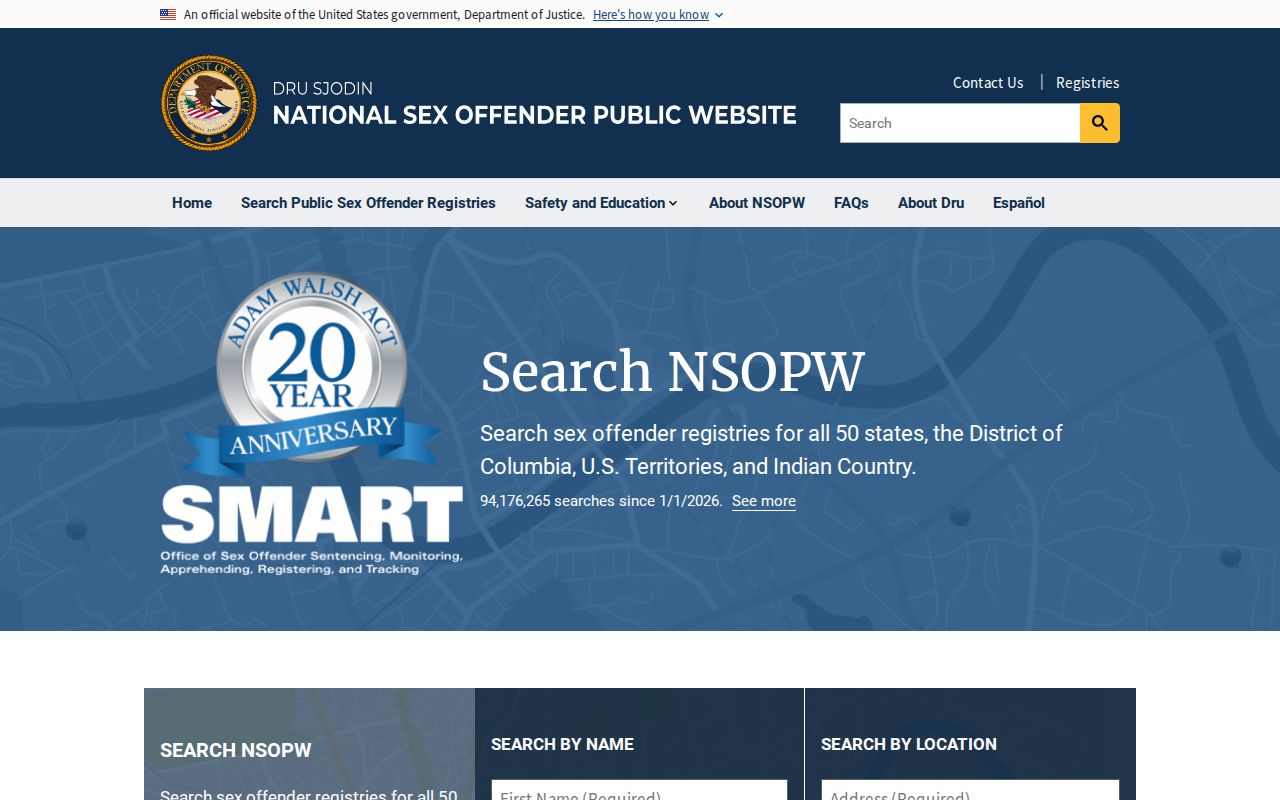
A national no-match should be read with care. Publicity rules, data timing, aliases, and geographic limits can affect results, so the Clark County registry remains the best source for local status.
Using Registry Information Lawfully
Washington authorizes community notice to support public protection. RCW 4.24.550 governs release of sex offender information, and Clark County uses risk levels to set the reach of that notice. The public record can support family safety plans, awareness of a known address, and a factual report to law enforcement. It is not permission to threaten, follow, shame, or interfere with a person or household.
Registry misuse warning: Misusing registry information to threaten, intimidate, or harass is a crime under Washington law. Clark County warns that such conduct will not be tolerated, while RCW 4.24.550 limits disclosure to public-protection purposes.
Keep the response tied to conduct and official channels. If a profile is unclear, ask the sheriff's unit. If a person appears noncompliant, report the specific facts. If there is an urgent risk, call emergency services. Those steps use the Clark County registry for its lawful safety purpose without turning public notice into private enforcement.